
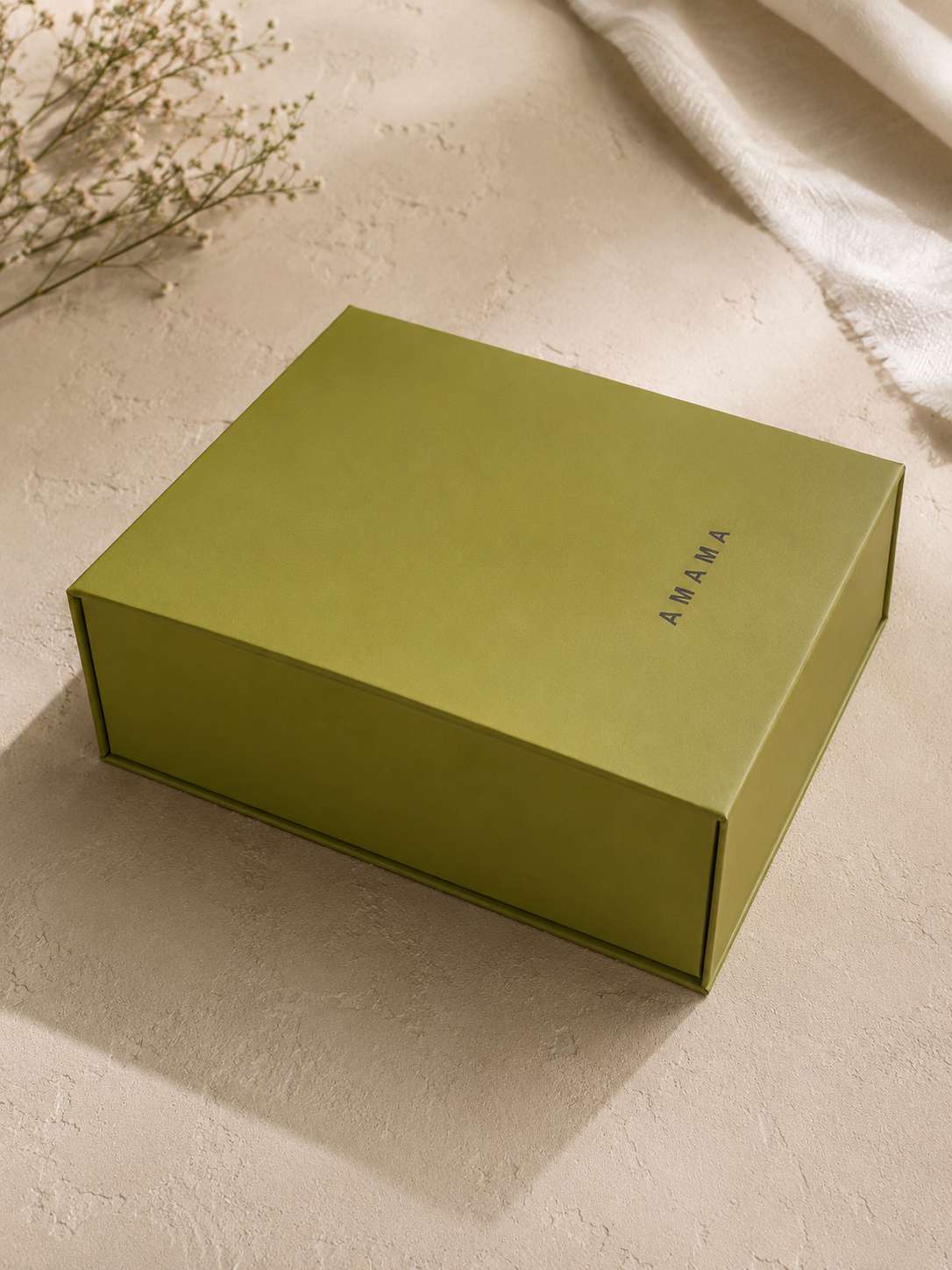
What is a rigid box?
A rigid box is a packaging box built from thick, non-bending greyboard or chipboard that is cut, corner-taped into shape and then wrapped in a printed or textured paper. Unlike a folding carton, it is supplied assembled and it holds its shape permanently, which is why it is the standard structure for luxury packaging boxes, perfume packs, jewellery cases and corporate gifting.
The board is usually 1.5 mm to 3 mm thick. That thickness is what gives the box its weight in the hand and its ability to protect heavy or fragile contents without an outer sleeve.
What are rigid boxes made of?
Every rigid box is a sandwich of three material decisions: the structural board, the wrap that carries the print and texture, and the insert that holds the product.
- Greyboard or chipboard, 1.5–3 mm, cut and corner-taped for the walls and base
- Wrap paper — coated art paper for photographic print, or linen, felt, laid and hand-made stocks for texture
- Lining paper or fabric — velvet, suedette or linen for trays and lids
- Inserts — die-cut paperboard, EVA foam, moulded pulp or thermoformed trays
- Hardware — concealed neodymium magnets, ribbon pulls, hinges and closures
The main rigid box constructions
Most projects resolve into one of six structures. The choice is driven by product weight, how many items sit in the box and the order in which they should be revealed.
- Magnetic closure boxes — hidden magnets in the flap, a flush lid and a silent close
- Drawer and slider boxes — an inner tray that pulls out of a wrapped sleeve
- Lid and base boxes — the classic two-piece structure, forgiving across sizes
- Book style boxes — a hinged, scored spine that opens like a hardcover
- Door style boxes — twin panels opening outward to present the contents
- Specialty shapes — hexagonal, cylindrical and custom die-lines around a non-standard product
Finishing options and what they cost you
Finishing is decided against the wrap, not chosen afterwards from a list. A foil that sits beautifully on an uncoated textured stock can look thin on a gloss laminate, and spot UV needs a matt base to read at all.
Gold foil printing and embossed logos add tooling cost but no per-unit press time once the die exists, so they get cheaper per box as quantity rises. Soft-touch lamination adds a film cost across the whole sheet.
- Hot foil stamping in gold, silver and pigment foils
- Embossing and debossing, single or multi-level
- Spot UV over matt lamination for contrast
- Soft-touch, matt and gloss lamination
- Screen printing for small solid areas on textured stocks
Where each rigid box type is used
Beauty and cosmetic packaging usually needs scuff-resistant lamination and an insert that grips glass. Perfume packaging boxes need weight-rated inserts and cap clearance. Jewellery packaging is judged on lining and hinge tolerance more than print. Corporate gift boxes are built backwards from a fixed content list.